Rail-Optimized Topology
Of the four fabric design patterns covered in 3.2 Design Options, Rail-Optimized Design (ROD) is the default. Almost every production AI training cluster between 1K and 10K GPUs uses it — NVIDIA's reference designs, Meta's training clusters, every major hyperscaler's "first-build" pattern. This whole course deep-dives ROD because mastering it gives you 90% of what you need; the other patterns (RUD, Scheduled, Multi-Planar) are situational and were summarised on the previous page.
So what is "rail-optimized" actually?
In a traditional DC, each server has one or two NICs, both connected to the same ToR. The ToR aggregates the whole rack — one cable bundle per server, one switch per rack.
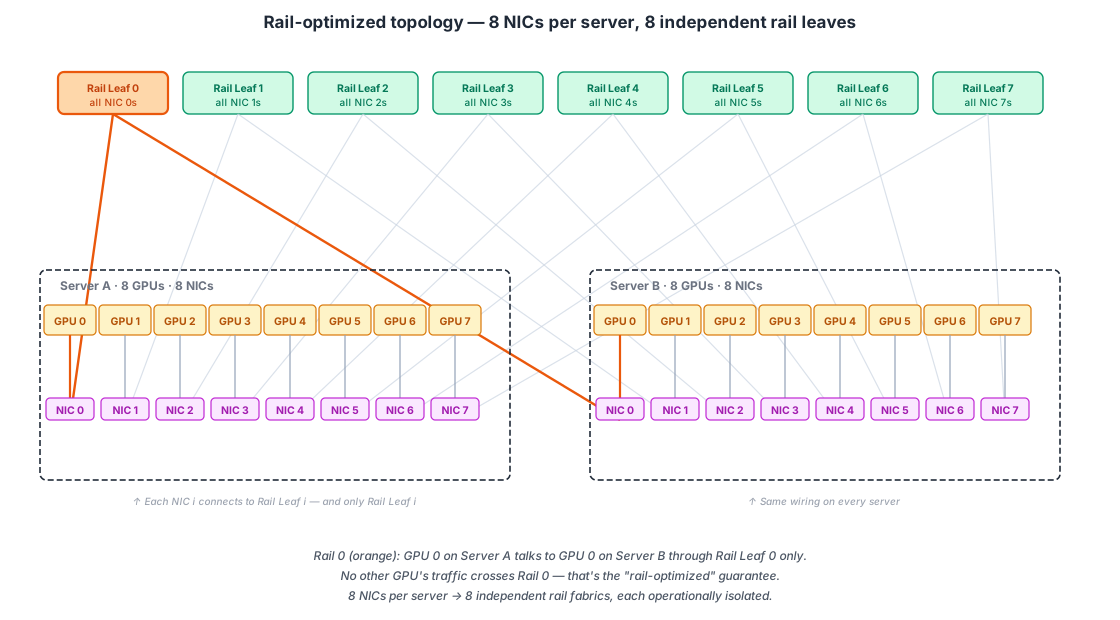
An AI training server has 8 NICs, and in a rail-optimized topology, each NIC goes to its own dedicated leaf switch. NIC 0 from every server in the pod connects to the same leaf — call it "Rail Leaf 0." NIC 1 from every server connects to "Rail Leaf 1." Eight NICs per host = eight independent fabric rails, each carrying same-index GPU traffic end-to-end. That's the structural twist that makes AI fabrics look weird at first sight. This page explains why.
- Define a rail — what wires to what, and why GPU index N on every host shares a leaf.
- Explain why rails exist — the ECMP-polarization, radix, and 1:1-oversub arguments that force the design.
- Reason about blast radius — what gets better (graceful 7/8 degradation, no cross-rail spread) and what gets worse (whole-host loss, shared-spine failure modes).
- Size a pod — pick the right GPU count, rail-leaf count, and pod ↔ rail layout for a given training job.
1. What is a rail?
A rail is one independent fabric, end to end:
- All the NIC-0s in the cluster connect to Rail Leaf 0.
- All the NIC-1s connect to Rail Leaf 1.
- ...all the NIC-7s connect to Rail Leaf 7.
So an 8-NIC-per-server cluster has 8 separate rail fabrics, each one operationally independent. They share the same spine layer (or have their own spine pairs in larger designs), but at the leaf they're isolated.
2. Why rails exist
The naive design — all 8 NICs to one ToR — has four problems, and they compound.
- Switch radix blows up. 8 × 400G = 3.2 Tbps of GPU egress into a single ToR. That ToR has to fan 3.2 Tbps back up to the spine, non-blocking. No commodity switch today fits that on one box at sane radix per host.
- 1:1 oversub becomes impossible at the rail level. Recap from 3.1 Understanding AI Fabric Architecture: AI fabrics are non-blocking. Aggregating 8 NICs onto one ToR forces you to oversubscribe somewhere — usually the uplinks. The moment you do, AllReduce eats the penalty as tail latency.
- ECMP polarizes hard on a single ToR. All 8 NICs share the same hash table, same uplink set, and the AllReduce flows from one host hash deterministically — 6 of 8 elephants pile onto one uplink, 2 sit idle. Owned in depth in chapter 4; the rail design is one of the structural mitigations.
- NCCL's ring algorithm needs an isolated path per rank. During AllReduce, GPU 0 on every host talks to GPU 0 on every other host (peer-to-peer for that rank). GPU 1 talks to GPU 1. Mixing those flows onto a shared ToR means cross-GPU traffic on one host contends with cross-host traffic for the same GPU. Hot spot.
The rail-optimized design fixes all four:
- Per-rail radix drops by 8. Each rail leaf sees only 1/8 of any one host's traffic. A commodity 32- or 64-port leaf handles a whole pod.
- 1:1 oversub is achievable per rail. Each rail leaf has the same downlink and uplink capacity. No hidden chokepoint.
- ECMP collision radius shrinks. Only same-index flows share a rail, so polarization is bounded to 1/8 of the cluster's elephants, not all of them. The full mitigation story (packet spraying, adaptive routing) is in chapter 4.
- The NCCL ring stays on one rail. Same-index traffic (GPU 0 ↔ GPU 0) is isolated end-to-end. No contention from other GPUs in the same host.
The key insight: in a distributed training job, GPU 0 talks to GPU 0. GPU 1 talks to GPU 1. Same index = same rail = isolated path. That property is what rail-optimized topology buys you, and it's why the design exists.
3. Blast radius — what gets better, what gets worse
Rails change failure modes in two ways.
What gets better
- A single rail-leaf failure loses 1/8 of each host's bandwidth. The job slows to 7/8 speed but keeps running. Graceful degradation.
- No cross-rail blast radius. A storm on Rail 3 doesn't touch Rails 0, 1, 2, 4, 5, 6, 7.
- One rail at a time can drain for maintenance. Job survives. That changes how you do upgrades — drain a rail, push firmware, bring it back, move to the next.
What gets worse
- A whole-host failure still loses all 8 GPUs at once (NICs aren't shared across hosts).
- Spine failure affects every rail simultaneously if spines are shared across rails. The mitigation is per-rail spine pairs — more switches, more cost, smaller blast radius.
- Cabling and labelling complexity is 8×. Every host has 8 cables going to 8 different leaves. Mislabelling is the most common day-1 install bug.
Skimping on rail-leaf count to save cost. If you build 4 rails instead of 8 "because most of the traffic is intra-host anyway", you'll meet your first elephant-flow collision at 70% AllReduce utilization and never recover. 8 GPUs = 8 rails. Always.
4. Pod sizing
A pod is a self-contained training fabric — typically sized so the topology is non-blocking at the rated GPU count.
Common sizes:
| Pod size | Typical structure |
|---|---|
| 128 GPUs | 16 servers × 8 GPUs · 8 rail leaves · 2-tier (no spine) |
| 256 GPUs | 32 servers × 8 GPUs · 8 rail leaves × 8 ports each · spine layer optional |
| 512–2048 GPUs | Multi-pod with 3-tier (leaf + spine + super-spine) |
| 10K+ GPUs | Multiple pods stitched across super-spines; sometimes with intermediate aggregation |
The super-spine is the tier that connects pods. It's where you'd cross-pod for very large training jobs (>1 pod size). Inter-pod traffic is slower (more hops) so the scheduler tries to keep jobs within a pod.
5. Pod ↔ rail interaction
Two combinations you'll see:
- One pod per rail. Each rail has its own pod. Pod 0 = all Rail 0 leaves and their spines. The "pod" boundary and the "rail" boundary are the same line. Simplifies operations — drain a pod, drain a rail, same thing.
- Rails span multiple pods. Rail 0 has multiple sub-pods, stitched through a super-spine. More common at very large scale (10K+ GPUs) where one pod can't hold the whole rail.
Either way, the GPU N ↔ GPU N dedicated-path property holds within a single rail's reach. Cross-pod traffic adds hops and pays for it in latency — the scheduler keeps a single job inside one pod whenever it fits.
💡 What you should remember
| 🛤️ | One rail per GPU index | NIC 0 → Rail Leaf 0, NIC 1 → Rail Leaf 1, …, NIC 7 → Rail Leaf 7. An 8-GPU host produces 8 independent fabrics. |
| 🎯 | Same-index traffic stays on the same rail | The NCCL ring keeps GPU N ↔ GPU N on Rail N — no contention from other GPUs on the host. |
| 📐 | 1:1 oversub is a per-rail property | Each rail leaf gets matched downlink/uplink capacity. The whole "no-oversub" promise of AI fabrics lives at the rail, not the pod. |
| 🔧 | Single rail failure = 1/8 bandwidth loss | Job continues at 7/8 speed. Graceful degradation, and one rail at a time can drain for maintenance. |
| 💥 | Whole-host failure still loses 8 GPUs at once | Rails don't help here — NICs aren't shared across hosts. Shared spines also fail-all-rails unless you split them per rail. |
| 📦 | Pods size in powers of 2 | 128, 256, 512, 1024, 2048 — chosen so the topology stays non-blocking. Super-spines stitch pods together at 10K+ scale. |
| 🪢 | Cabling is 8× more complex | Every host has 8 cables fanning out to 8 different leaves. Mislabelling is the day-1 install bug — own the label scheme before the first host racks. |
Next: Switches for AI → — the dominant switch vendors and the network OS each runs, then the silicon underneath and the NICs at the host edge, before sizing & cabling turns the design into a build plan.