NCCL Is Becoming a Network KPI: Why Rubin Makes Collective Performance a Fabric Metric
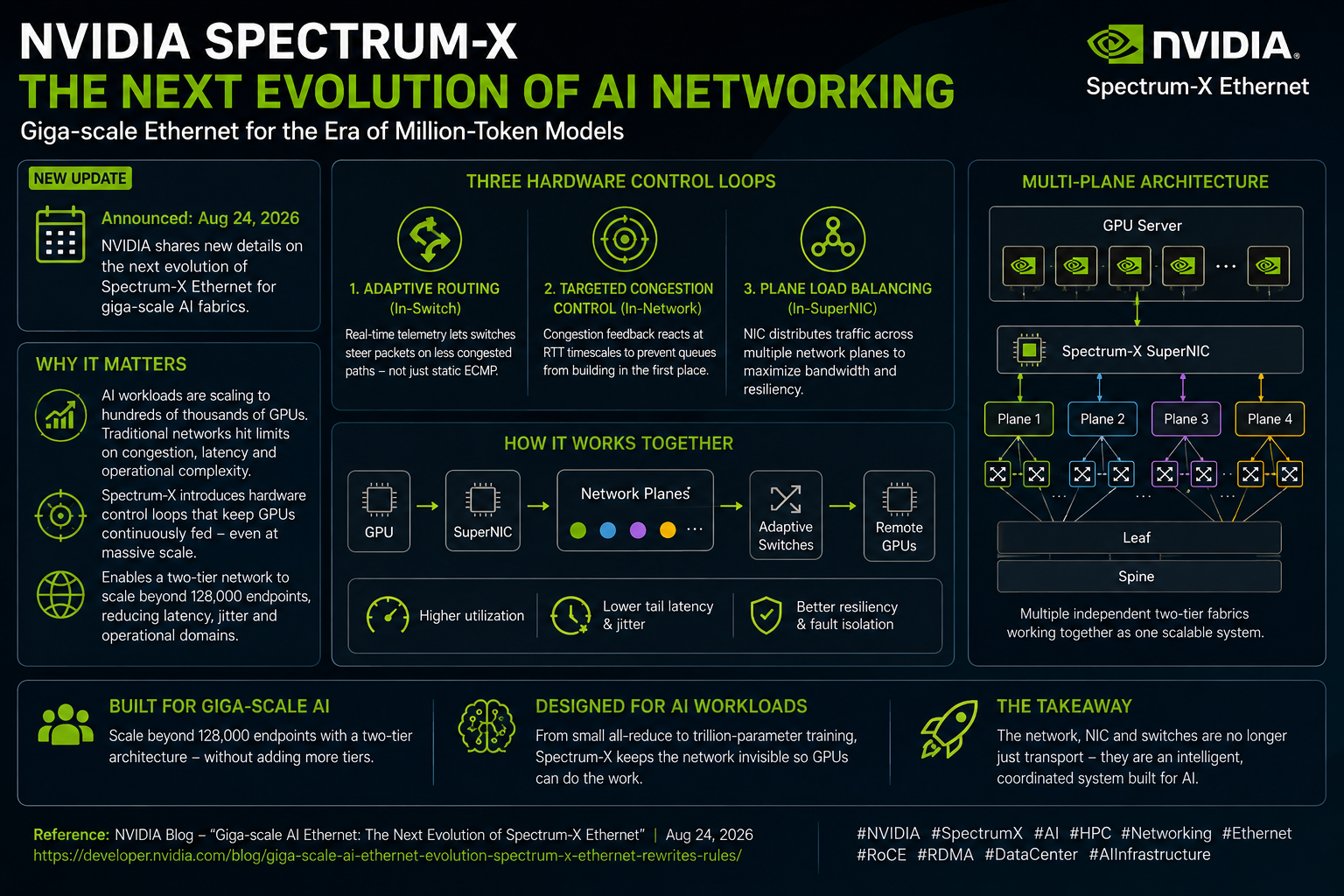
TLDR: NVIDIA NCCL 2.32.3 adds initial Vera Rubin support, including ConnectX-9 rail and plane detection. That is more than a software-library update. It reinforces an important operational shift for AI infrastructure: network teams increasingly need to validate the fabric through collective performance, not only link state, routing adjacency and packet counters.
The interesting part of NCCL 2.32.3 is not the version number
NVIDIA released NCCL 2.32.3 on September 22, 2026, with support for CUDA 12.x and CUDA 13.x.
The release notes include something especially relevant to network engineers:
- initial Vera Rubin platform support;
sm107support;- ConnectX-9 rail and plane detection;
- MPS + MLoPart support.
NVIDIA also notes that this release focuses on functionality and does not yet include Rubin performance-model tuning; that tuning is planned for a later release.
That detail matters.
The collective communication library is becoming increasingly aware of the physical topology underneath the workload.
The path is no longer abstract:
GPU
 |
NCCL collective
 |
NVLink / PCIe
 |
ConnectX-9 SuperNIC
 |
rail / plane selection
 |
RDMA / RoCE
 |
Spectrum-X fabric
 |
remote SuperNIC
 |
remote GPU
When NCCL can understand rails and planes, the boundary between "application performance" and "network topology" becomes much thinner.
Why network engineers should care about NCCL
Traditional network validation usually starts with infrastructure health:
BGP established
interfaces up
CRC errors = 0
packet drops = 0
expected routes installed
All of those checks are still necessary.
But they are not sufficient for an AI fabric.
A distributed GPU workload can underperform while every conventional network check remains green.
Consider an AllReduce running across hundreds of GPUs.
If one path becomes congested:
queue occupancy increases
        |
        v
ECN marks increase
        |
        v
RDMA congestion control reacts
        |
        v
one rank transfers more slowly
        |
        v
collective completion time increases
        |
        v
other GPUs wait
No interface has to go down.
No route has to disappear.
The network is available, but the AI system is not making progress at the expected rate.
That is why NCCL performance is becoming useful as a network KPI.
What an NCCL test actually exercises
At multi-node scale, a test such as all_reduce_perf is not just a GPU benchmark.
It exercises much of the real communication path:
GPU memory
   |
PCIe / NVLink
   |
SuperNIC
   |
RDMA transport
   |
switch ingress queue
   |
fabric path
   |
switch egress queue
   |
remote SuperNIC
   |
remote GPU memory
This makes NCCL useful for validating the network before and after a change.
Imagine a switch software or NIC firmware upgrade.
Before the change, capture:
- NCCL algorithm bandwidth;
- NCCL bus bandwidth;
- GPU utilization;
- NIC throughput;
- ECN marks;
- CNP rate;
- queue occupancy;
- PFC counters where applicable;
- rail or plane utilization;
- FEC and CRC counters;
- optical health.
After the change, run the same workload and compare.
A successful maintenance event should mean more than:
BGP came back.
It should mean:
the workload returned to the expected collective performance.
Rail and plane awareness becomes important with Rubin
Vera Rubin increases the importance of topology awareness.
NVIDIA's current Spectrum-X roadmap pairs Rubin with ConnectX-9 SuperNICs and Spectrum-6 Ethernet switching.
ConnectX-9 can provide up to 1.6 Tb/s of scale-out bandwidth per GPU.
Spectrum-6 provides 102.4 Tb/s of switching capacity.
At those injection rates, a GPU server can generate an enormous amount of synchronized east-west traffic.
A single logical network path is no longer enough to think about the system.
Modern AI fabrics increasingly use multiple rails and multiple network planes.
Conceptually:
                         +--> Plane 1 -->+
                         |               |
GPU --> ConnectX-9 ------+--> Plane 2 -->+----> remote GPU
                         |               |
                         +--> Plane N -->+
The goal is to provide more path diversity while keeping the topology relatively flat.
NVIDIA's Spectrum-X Multiplane architecture places a hardware Plane Load Balancer inside the SuperNIC. The operating system and collective libraries can see a unified RoCE device while the hardware handles traffic distribution and failover across planes.
That is an important architectural change.
The endpoint is becoming an active part of fabric utilization.
Why static ECMP is not enough for synchronized GPU traffic
Traditional Ethernet fabrics commonly rely on flow-level ECMP.
That works well for many application workloads.
AI collectives create a harder traffic pattern.
Thousands of large flows can start at nearly the same time.
If several elephant flows hash onto the same path:
Flow A ---> Spine 1
Flow B ---> Spine 1
Flow C ---> Spine 1
Flow D ---> Spine 4
Spine 1 can become congested while other paths have available capacity.
The fabric may have enough aggregate bandwidth.
The workload simply cannot use it efficiently.
That is why newer AI Ethernet designs combine:
- adaptive routing;
- endpoint-aware path selection;
- richer congestion telemetry;
- hardware plane load balancing;
- fast failure bypass;
- topology-aware collective communication.
The objective is not just packet delivery.
It is predictable collective completion time.
The troubleshooting hierarchy has to change
A traditional network troubleshooting hierarchy often looks like:
device
 |
interface
 |
route
 |
packet
For AI infrastructure, a more useful hierarchy is:
AI job
 |
GPU utilization
 |
NCCL collective
 |
NCCL algorithm / bus bandwidth
 |
GPU-to-NIC locality
 |
SuperNIC throughput
 |
RDMA flows
 |
ECN / CNP
 |
PFC where used
 |
queue occupancy
 |
rail / plane utilization
 |
FEC / CRC
 |
optics
This allows the operations team to answer a much more useful question:
Where did the collective lose performance?
That question is far more actionable than spending hours proving that every switch interface is up.
A practical validation workflow
For production AI fabrics, I would increasingly treat a known NCCL workload as part of the network change process.
Before maintenance
Establish a repeatable baseline:
NCCL test
   |
   +--> algbw
   +--> busbw
   +--> iteration time
   +--> GPU utilization
   +--> per-NIC throughput
   +--> per-rail / per-plane utilization
   +--> ECN / CNP counters
   +--> queue occupancy
   +--> FEC / CRC
Perform the change
Examples:
- switch NOS upgrade;
- SuperNIC firmware upgrade;
- routing-policy change;
- congestion-control tuning;
- optic replacement;
- rail or plane maintenance.
After maintenance
Run the identical NCCL workload again.
Compare the workload and network telemetry together.
For example:
Links:          healthy
BGP:            healthy
CRC:            zero

NCCL busbw:     -12%
ECN marks:      increased
Plane 1:        92%
Plane 2:        48%
That tells us something traditional health checks missed.
The network recovered.
The AI fabric did not recover to the same performance.
Fail-slow is the real operational challenge
Hard failures are relatively easy to detect.
A dead link produces obvious signals.
AI fabrics are often more vulnerable to fail-slow behavior:
degraded optic
imbalanced rail
congested queue
bad NIC
PCIe locality issue
partial bandwidth reduction
slow network plane
The system continues functioning.
But one participant becomes slower.
In tightly synchronized collectives, that one slow participant can reduce the effective performance of many GPUs.
This is why network observability needs to connect physical infrastructure with workload behavior.
The useful correlation becomes:
Job
 |
NCCL rank
 |
GPU
 |
NIC
 |
RDMA flow
 |
fabric path
 |
switch queue
 |
optic
What changes for network reliability engineering
For traditional infrastructure, reliability often means:
availability + packet delivery
For an AI factory, I think the definition expands to:
availability
+
predictable communication
+
collective completion time
+
useful GPU progress
This does not mean network engineers become CUDA developers.
It means the network team's observability boundary needs to move one layer higher.
If a network event reduces NCCL performance, that is a networking impact even when no interface went down.
Final thought
NCCL 2.32.3 adding Rubin support and ConnectX-9 rail/plane detection is a small release-note item with a much larger implication.
The collective communication layer is becoming more topology-aware at the same time the network endpoint is becoming more intelligent.
That convergence changes AI-fabric operations.
For traditional networks, we ask:
Can the application reach the destination?
For AI networks, the better question is:
Can thousands of accelerators communicate predictably enough to keep making useful progress?
That is why NCCL performance should increasingly become a production network KPI.