Spectrum-X Is Growing 2.6x: Why NVIDIA's Networking Business Matters More Than the Headline
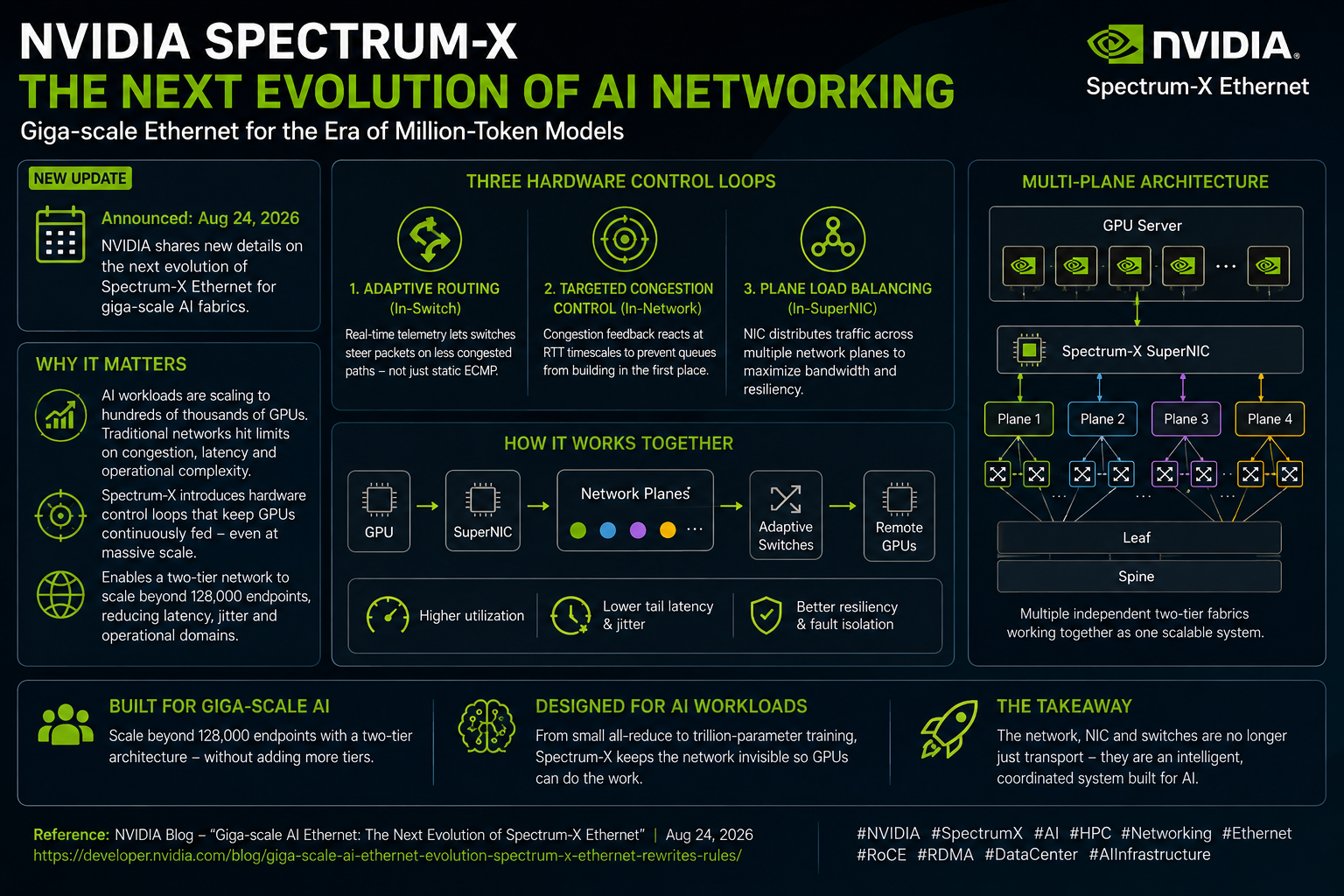
TLDR: NVIDIA reported another record networking quarter, with networking revenue growing 18% sequentially and Spectrum-X Ethernet growing 2.6x year over year. The important story is not simply that NVIDIA is selling more switches. AI infrastructure is forcing compute, NICs, congestion control, topology, optics and collective communication to be engineered as one system — and NVIDIA is capturing more of that system with every generation.
The number that caught my attention
NVIDIA's Q2 FY2027 earnings call contained an important networking datapoint: its networking business reached another record quarter, growing 18% sequentially, while Spectrum-X Ethernet grew 2.6x year over year.
NVIDIA said this growth is helping it become the world's largest and fastest-growing networking company.
For network engineers, the interesting question is not whether that marketing claim is perfectly comparable with every traditional networking vendor.
The interesting question is:
Why is networking becoming such a large part of an AI compute company?
The answer is that at AI-factory scale, the network is no longer infrastructure sitting underneath compute. It directly determines how much useful work the GPUs can perform.
GPU performance is becoming network performance
A simplified distributed training job looks like this:
GPU 0 ----\
GPU 1 -----\
GPU 2 ------> collective communication ---> next iteration
GPU 3 -----/
GPU N ----/
The GPUs perform compute, but they repeatedly need to synchronize gradients, exchange parameters, move expert tokens or communicate intermediate state.
That produces operations such as:
AllReduce
AllGather
ReduceScatter
All-to-All
If one part of the fabric slows down, thousands of GPUs can wait.
Fast GPUs
   |
   v
Network congestion
   |
   v
Collective takes longer
   |
   v
GPU waits
   |
   v
Lower GPU utilization
   |
   v
Higher cost per token
This is why AI networking economics are fundamentally different from many traditional enterprise networks.
A network problem is not merely a packet problem. It can become an accelerator-utilization problem.
Spectrum-X is not just an Ethernet switch
It is tempting to compare Spectrum-X with a traditional switch product line.
But NVIDIA positions Spectrum-X as an end-to-end AI Ethernet platform combining:
GPU / XPU
   |
ConnectX SuperNIC
   |
RDMA / RoCE
   |
Congestion-control telemetry
   |
Spectrum-X switch
   |
Adaptive routing
   |
Remote SuperNIC
   |
Remote GPU
The switch and SuperNIC coordinate to make decisions about how AI traffic moves through the fabric.
That is the architectural distinction worth understanding.
Traditional Ethernet commonly treats the host and network as relatively independent systems. NVIDIA is increasingly co-designing the endpoint and fabric.
Why ordinary ECMP becomes difficult for AI
Consider a four-spine topology:
                 Spine 1
               /         \
              /           \
Leaf A ------ Spine 2 ------ Leaf B
              \           /
               \         /
                 Spine 3
                    |
                 Spine 4
Suppose several elephant RDMA flows hash onto the same path.
Flow A -> Spine 2
Flow B -> Spine 2
Flow C -> Spine 2
Flow D -> Spine 4
The fabric may have plenty of aggregate capacity while Spine 2 becomes congested.
For ordinary application traffic, this may be tolerable.
For synchronized AI collectives, one congested path can delay the entire iteration.
This is why modern AI fabrics increasingly use mechanisms such as adaptive routing, richer congestion telemetry and endpoint-aware path selection.
The SuperNIC changes the architecture
One of the most important parts of Spectrum-X is the SuperNIC.
The NIC is no longer simply:
server -> Ethernet frames -> network
It increasingly participates in:
RDMA offload
congestion control
telemetry
adaptive routing
collective communication
multi-tenant isolation
That changes the troubleshooting boundary for network engineers.
Instead of beginning at the switch port, an AI-network investigation may need to start inside the server:
GPU
 |
HBM
 |
NVLink / NVSwitch
 |
PCIe
 |
SuperNIC
 |
RDMA
 |
Ethernet fabric
 |
Remote SuperNIC
 |
Remote GPU
A perfectly healthy switch cannot compensate for poor GPU-to-NIC locality, PCIe problems or endpoint congestion behavior.
Spectrum-6 raises the scale again
The next generation of Spectrum-X uses NVIDIA's Spectrum-6 switch silicon.
Spectrum-6 provides 102.4 Tb/s of switching capacity and uses 200G SerDes. NVIDIA's SN6600 exposes 128 ports of 800G connectivity, while the SN6800 scales to 512 800G ports in a chassis form factor.
The accompanying ConnectX-9 generation is designed for Vera Rubin-era systems and up to 1.6 Tb/s of network bandwidth per GPU through multiple high-speed lanes.
At these speeds, a single GPU server can inject extraordinary amounts of east-west traffic.
The fabric must therefore scale not only in raw bandwidth, but also in path diversity, congestion response, failure recovery and operational visibility.
Multiplane is one of the most important changes
NVIDIA is also pushing Spectrum-X toward multiplane topologies.
Instead of one monolithic fabric:
GPU
 |
NIC
 |
       One large Clos
traffic can be distributed across independent network planes:
                     +--> Plane 1 -->+
                     |               |
GPU --> SuperNIC ----+--> Plane 2 -->+----> Remote GPU
                     |               |
                     +--> Plane N -->+
NVIDIA says Spectrum-X Multiplane can scale to 128,000 GPUs in a two-tier topology by splitting SuperNIC traffic across multiple independent planes.
The architectural benefits are significant:
- flatter topology;
- more path diversity;
- smaller failure domains;
- fewer switches than deeper Clos designs;
- better ability to bypass failures;
- lower latency and jitter from avoiding another switching tier.
This is particularly interesting because other next-generation AI Ethernet designs are converging on similar ideas: smarter endpoints combined with many parallel paths.
Ethernet vs. InfiniBand is becoming the wrong question
For years, the common AI-networking discussion was:
InfiniBand
    vs
Ethernet / RoCE
That comparison is becoming too simplistic.
NVIDIA itself now has major platforms on both sides:
Scale-out AI networking

        NVIDIA
       /      \
Quantum      Spectrum-X
InfiniBand    Ethernet
The real architectural questions are increasingly:
- How does congestion control behave?
- How efficiently are multiple paths used?
- How quickly can the fabric recover from failures?
- How much endpoint intelligence exists?
- How much telemetry is available?
- How predictable are collective completion times?
- What happens when the network scales beyond tens of thousands of GPUs?
The protocol label alone does not answer those questions.
SONiC is strategically important here
Another detail network engineers should notice is that NVIDIA continues to position Spectrum-X as standards-based Ethernet with support for open network operating systems including SONiC.
That matters because AI networking is not necessarily moving toward closed operational models even as the hardware becomes increasingly co-designed.
The emerging combination can look like:
AI-optimized silicon
       +
open Ethernet
       +
SONiC / Linux
       +
RDMA
       +
endpoint telemetry
       +
adaptive routing
For engineers already experienced with BGP, SONiC, telemetry and automation, AI fabrics are an extension of those skills rather than a complete replacement.
The additional layer is understanding GPU communication behavior.
Spectrum-XGS expands the failure domain beyond one data center
NVIDIA is also extending Spectrum-X into Spectrum-XGS, its scale-across architecture for connecting AI infrastructure across separate facilities.
NVIDIA says Spectrum-XGS uses topology-aware congestion control, latency management and end-to-end telemetry to improve NCCL performance across geographically separated data centers.
That creates a new architecture:
AI Factory A
    |
Spectrum-X
    |
Spectrum-XGS
    |
DCI / optical transport
    |
Spectrum-XGS
    |
Spectrum-X
    |
AI Factory B
Once collective traffic crosses buildings or campuses, the network engineer must reason about much more than leaf-spine congestion.
Latency variation, optical transport, DCI capacity, failure domains and topology awareness all become part of accelerator performance.
Co-packaged optics is part of the networking strategy
Spectrum-X Ethernet Photonics integrates co-packaged optics into the switch architecture.
NVIDIA says its CPO systems can improve network power efficiency and reliability compared with conventional pluggable optics.
This matters because power is becoming one of the hard limits on AI-factory scale.
A simplified power budget increasingly looks like:
Total facility power
       |
       +--> GPUs
       +--> CPUs
       +--> memory
       +--> networking
       +--> optics
       +--> cooling
Every watt consumed by the network is a watt that cannot be used elsewhere without increasing facility capacity.
At hundreds of thousands of GPUs, optical power and reliability become architectural issues rather than component-selection details.
Why the 2.6x growth matters strategically
NVIDIA's business opportunity has expanded beyond selling GPUs.
The stack now increasingly looks like:
              AI workload
                   |
                  CUDA
                   |
              Rubin GPU
                   |
               NVLink 6
                   |
              ConnectX-9
                   |
              Spectrum-6
                   |
            Spectrum-XGS
                   |
              BlueField
                   |
              AI storage
The more of this stack NVIDIA supplies, the larger its revenue opportunity per megawatt of AI infrastructure.
NVIDIA said its revenue opportunity has increased from roughly $18 billion per gigawatt in the Hopper generation, to $25 billion with Blackwell, to about $40 billion with Vera Rubin.
Networking is one reason that opportunity is expanding.
The strategic shift is straightforward:
Old NVIDIA

GPU company

        ->

AI-factory platform

GPU + CPU + NVLink + NIC + DPU + Ethernet + InfiniBand + optics + software
What this means for network engineers
The growth of Spectrum-X sends a strong career signal.
The most valuable AI-network engineer will increasingly understand the entire communication path:
Application / framework
        |
NCCL collective
        |
GPU / HBM
        |
NVLink / NVSwitch
        |
PCIe / NUMA
        |
ConnectX / SuperNIC
        |
RDMA transport
        |
ECN / congestion control
        |
rail / plane selection
        |
leaf / spine queues
        |
optics / FEC / BER
        |
remote GPU
The switch remains important, but it is only one component in the performance chain.
What I would study from this announcement
If you work on large-scale networking, these are the areas worth understanding behind the Spectrum-X growth story:
- RoCEv2 fundamentals — RDMA, PFC, ECN, CNP and congestion control.
- Adaptive routing — why static ECMP becomes inefficient for synchronized elephant flows.
- Multiplane fabrics — failure domains, path diversity and flatter topologies.
- GPU-to-NIC locality — PCIe and NUMA placement can determine achievable network performance.
- NCCL collectives — especially AllReduce, ReduceScatter, AllGather and All-to-All.
- 800G and 1.6T optics — including SerDes, FEC, BER and co-packaged optics.
- SONiC and automation — because operating tens of thousands of fabric endpoints requires software-first operations.
- Network-to-GPU observability — correlating switch queues with NIC counters, RDMA behavior and GPU stalls.
Final thought
The most important part of NVIDIA's networking growth is not the revenue number.
It is what the revenue tells us about AI architecture.
Compute performance
       |
       v
Communication performance
       |
       v
Network performance
       |
       v
GPU utilization
       |
       v
Tokens / second
       |
       v
AI economics
At AI-factory scale, the network is becoming part of the computer.
Spectrum-X growing 2.6x year over year is strong evidence that customers are spending accordingly.
For network engineers, that is an opportunity: the skills required to design, automate and troubleshoot these fabrics are moving closer to the center of the AI infrastructure stack.